
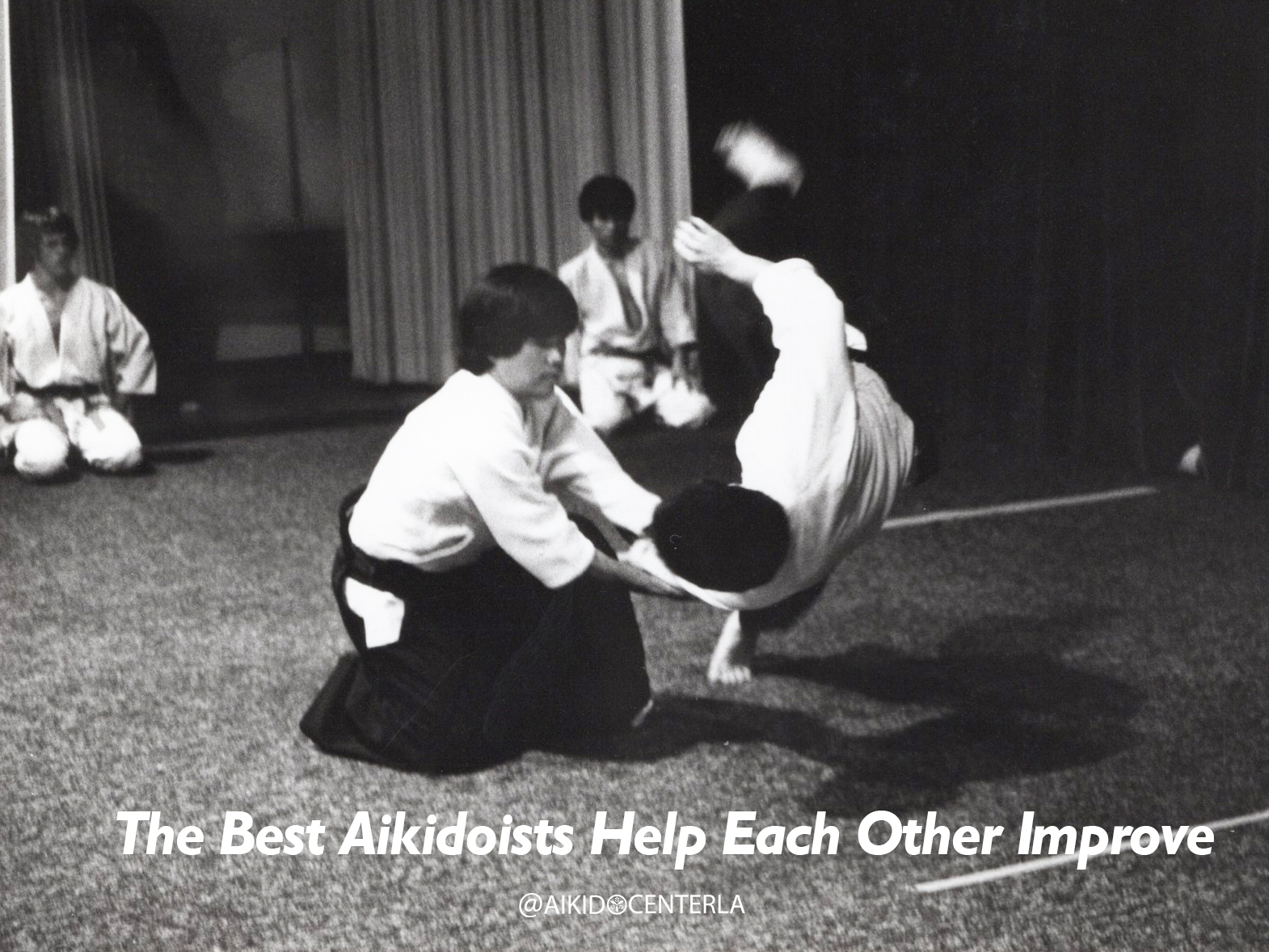
The best Aikidoists improve each another.
Earlier this year, I saw an old senpai (先輩) or “senior” of mine who was a real jerk to me 30+ years ago. He was so mean to me that on my second day, he beat me up because he got frustrated for one reason or another. Now, whenever I see him, he likes to jokingly remind me how horrible I was when I started and that he is still my senpai. For years, I used to secretly hate him because he was always so mean to me (even now my elbow is still injured because of him). When I passed the test for shodan or “first degree black belt,” he reached out his hand to congratulated me and said, “I knew you could do it.”
As a beginner, I didn’t understand that mastery is only because of soudai (相待) or “interdependence." Soudai is a Buddhist term which also means “in opposition.” Therefore, the paradox of mastery is that it only can occur when we simultaneously work together in mutual opposition of one another. In the west we say, “iron sharpens iron.” This means that when a harder piece of iron is drawn against a softer piece of iron or steel, it can sharpen the softer piece. Irons with a similar hardness can still sharpen one another, but it's a slower process which also can wear down both pieces at the same time. In Japanese, they don’t have this idiom so they say sessatakuma (切磋琢磨) or that improve is a result of “the mutual encouragement to improve.” Thus, we have to go up against bigger or stronger opponents or choose harder paths because that opposition helps us to find our highest level.
In class, we sessatakuma by how much resistance we give to our training partners. How much resistance we give them depends on their level or capacity. Furuya Sensei used to say, “Take it to their level and one step further.” He said “one step” because he knew that growth happens just outside of our comfort zones. Therefore, that one step can either destroy or develop a student. Too much resistance is to tatakau (戦う) or “to wage war” upon them and can destroy them. Too little does nothing to push them out of their comfort zone. Just the right amount uncomfortableness enables us to katahadanugu (片肌脱ぐ) or “to lend a helping hand” in their development.
The literal translation of katahadanugu is “to bare one shoulder.” What training is trying to teach us to be better people who help instead of hurt - we choose compassion over contempt. Thus, in order to be of service to others, when we see that they are struggling we should slide in and bare one shoulder. In a training sense, we take on the responsibility to help this person improve by applying just the right amount of resistance which helps instead of hurts.
When I look back now on my time with that senpai, I realize that he had to be a jerk because that is what I needed. I am the type of person who’s potential and capacity are as such that I need something or someone to strongly push against. Thus, I needed him to be a jerk because I could take it and I couldn’t grow without it. In Aikido and in Life, within the greater opponents or obstacles lies the greatest opportunities for improvement.
Today’s goal: When something uncomfortable happens, don’t forget that “everything happens for you, not to you.”
Watch this short video of Japanese kids doing sessatakuma